Showing posts with label Nikos Kazantzakis. Show all posts

Tuesday, 5 March 2024

Temple of Heaven

    I like old travel books very much. I have a copy of Washington Irving's Tales of the Alhambra, which was first published around two hundred years ago, and which I keep because I hope one day to travel overland from the north to the south of Spain. It may seem incredible that my main motivation for holding onto the book is to see whether a couple of his observations about Spain still hold true. 


    I've always found these antiquated texts to be a great source of travel inspiration. Imagine my delight, then, when I rediscovered my copy of Nikos Kazantzakis' book Japan, China, written in 1935, in a flat in Beijing. It had lain there undisturbed, in the dark, for at least five years.

    So it was that I decided to go to the Temple of Heaven. Kazantzakis had left this memorable description of his visit ninety years ago:

   ... you climb up farther and you reach the third, the highest terrace. All around as far as the eye can see, an endless plain, the desert that surrounds Peking. And your head feels that it is elevated in the sky...

    Spindly cypress trees line the long avenue that leads from the West Heavenly Gate of the Temple of Heaven. Eventually you turn left, and head towards a large enclosure. In the centre, up three sets of marble steps, is the Hall of Prayer for Good Harvests, where the Emperor 'offered sacrifices to pray for bumper harvests and favourable rain'. It's a magnificent edifice, with a three tiered roof of blue tiles. You can't enter the hall, but you can peer into the dark interior. Being tall, I was able to avoid the melee that formed outside each of the apertures.


    The panorama from the top platform, whose stone surface is crumbling from the heavy tread of countless visitors, is special. It's not very high, but Beijing is such a flat city that you can see for miles. Outside the walls is what looks like a forest of tightly packed trees, then, in the distance, you can see the urban landscape of Beijing. Beyond that, to the north west, is a mountain range, only visible on clear days when the cold north wind chases the haze and clouds away (I went twice, so I know). The desert Kazantzakis spoke of has been covered by buildings, but you can sense it in the dry, dusty air.  


    Kazantzakis was moved by his visit all those years ago:

   When I ascend to the Temple of Heaven... I feel that man is truly sacred, mysterious, a wheel full of magic powers that creates matter in the image of his heart.

    Those days are long gone, however. Now the Temple of Heaven is the territory of attractive young women having their pictures taken. Some are in traditional Chinese dress, while others are fabulously, if rather incongruously, attired in high heels and very swish coats and dresses. Some have a retinue: a photographer, and someone else whose role I couldn't determine. Apparently, having their pictures taken here is a social media phenomenon. At any rate, they really know how to pose for the camera. 


Tuesday, 20 September 2022

The Craze for Japan

 In a glass cabinet inside a magnificent white room in the centre of London there is a book. It was published over a hundred years ago, to mark the 1910 Japan-British Exhibition in the capital, and it's open at pages 22 and 23. I do not exaggerate when I write that, as I read the text on the left hand page, I could feel the hairs on the back of my neck stand up. 


   Perhaps I'm particularly susceptible to the written word. One of my few treasured possessions is a book by Nikos Kazantzakis called Zorba the Greek, whose last chapter I have defaced with highlighter. I think it might be the greatest thing I've ever read, and when I open the pages, yellow with the passage of two decades, I feel the same sense of shivery excitement I experienced in London. 

   What set me off at The Craze for Japan exhibition was nothing more than a passage about the temples of Kyoto. The names were as familiar to me as household words: Ginkakuji, the Silver Temple, which is in fact not silver but boasts a wonderful garden; Nanzenji, with its viaduct and rock garden; Heian Jingu, famous for its massive orange torii gate. My mind swelled with the memory of sweat-drenched walks around these places. 

   Two temples, however, were unknown to me. One of these, 'Kurodanin', is in the north of the city, I learned, and is notable (at least it was, a hundred years ago) for 'two curiously trained pine trees'. One of these was called 'fan-shaped pine', while the other was known as 'yoroikake-no-matsu', so-named 'because warrior Naodane is said to have hung up'... who knows? For here, the page ended. 

   Reading that single page, and seeing black and white images of Kinkakuji, the Golden Temple, blanketed in snow, and the wooden temple Byodo-in, filled me on a sudden with the urge to return to that great city.  I hadn't been since 2016, which now felt like an eternity! I would go to Kurodanin and discover if one of those pine trees does indeed look like a fan, and find out who Naodane was and what on earth he hung up. 

   Inspiration comes at unexpected moments. In my case, it came courtesy of a free and low-key exhibition which I only learned about because I happened to be in London, and because I have fond memories of Green Park. If you like Japan, I recommend you go too. 

   The Craze for Japan in Victorian and Edwardian Britain is open from 10 a.m. to 5 p.m. from Monday to Friday at the Embassy of Japan on Piccadilly. 


Saturday, 5 July 2014

In the footsteps of Nikos Kazantzakis in Japan


          Through a grille in a thirteen hundred year old wooden pagoda I see them: tiny clay figures of incredible age, their expressions concealed by the semi-darkness. Unlike the handful of squinting Japanese around me, I was prepared for this. Feeling like a minor criminal, I grab my flashlight and direct the weak beam at the scrawny ascetics before me. They are ululating and pounding their chests in lamentation, mourning the passing of the Buddha in their midst.


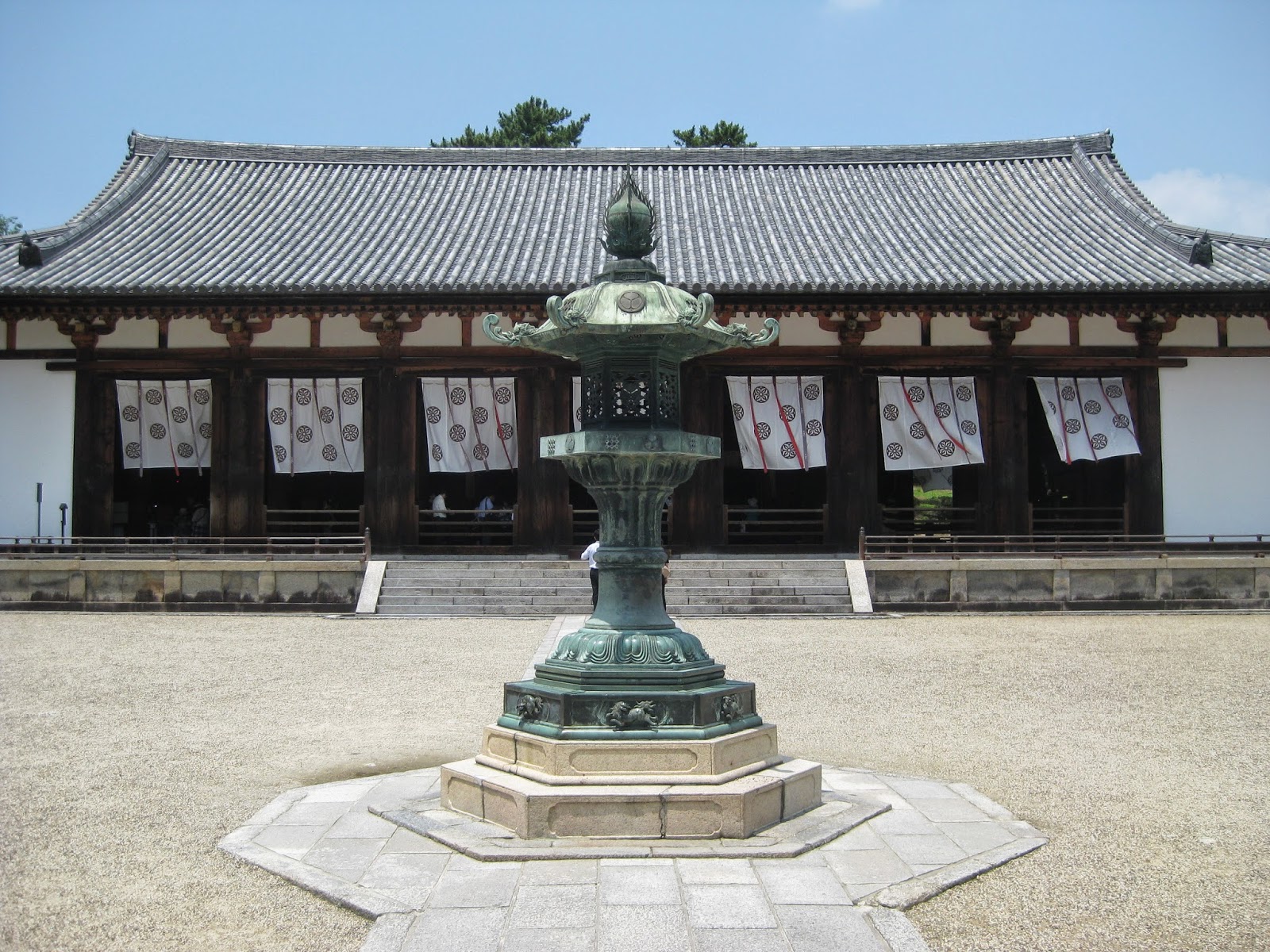
          I did not come to Horyu-ji to see these miniature statues, though. I was instead inspired by a description I chanced upon in a musty biography of one of my favourite writers: Nikos Kazantzakis. A student of Buddhism, he made a pilgrimage here in 1935, and raved about it in a letter to his wife in these terms: “Exquisite. Peaceful, pagodas, springtime-sweet air, Buddhas smiling in the half-light, paintings on silk, dancing girls and, above all, the goddess Kwannon, the goddess of mercy. This is the most beautiful statue I’ve ever seen.’


          On this late June day, however, the air is not springtime-sweet. The sun is bright, ferocious and dazzling. For once I look at the umbrella-wielding Japanese women with something other than scorn. Nor is it especially peaceful. Smart tour guides with blue flags and squeaky voices march hordes of bored-looking Japanese junior high school children around the large grounds at military pace. Occasionally, a shout of ‘atsu!’ (hot!) from one of the boys rises above the general murmur.  


          There’s a dearth of foreigners, or at least white people at Horyu-ji, underlining the fact that it’s not that easy to get to. It took me two hours from Kyoto Station, first on a slow-paced local train along a single-track railway to Nara, then across a tableland of saturated rice fields and ugly houses to the dusty town of Ikaruga. Green hills could be seen in the distance in all directions. After a fifteen minute walk in unforgiving heat and humidity I reached a long and narrow avenue of sloping pines. It seemed a fitting approach to one of Japan’s oldest temples.  


          Indeed, according to the tourist bumf, Horyu-ji is home to ‘the world’s oldest surviving wooden structures’, among whose number is the aforementioned five-story pagoda. Looking at this brown and white edifice with its deep eaves, I find the claim hard to believe: rather disappointingly, it looks in great shape. I had hoped for a sight redolent of antiquity that would send a thrill though my body. Of more interest are the immense and discoloured clay guardians, with their rippling muscles and fearsome expressions, that protect the central gate. Now they do look old. 


          As I leave the spacious western precinct, exiting through the long and shady cloister gallery, I feel a thrill of excitement. Ahead in the gallery of treasures the statue of the goddess Kannon waits, the one Kazantzakis called the most beautiful he’d ever seen. It stands before a mandorla in a hall of its own, a remarkably tall and slight wooden figure, with long arms and a water vase in its left hand. The figure is feminine, but the face looks more like a man’s. 


          It’s a mesmerising sight, well over a thousand years old, but is it the one Kazantzakis spoke of? Later, back in Tokyo, I discover that Horyu-ji houses another celebrated statue of Kannon, a so-called ‘secret Buddha’ that can only be seen in the spring and fall. I guess I’ll never know.