Showing posts with label Tokyo. Show all posts

Friday, 22 November 2024

Montes Alpha

           One of the great things about wine is the way it can transport you back to the past.


I had this experience recently when a friend and I shared a bottle of Bodegas Zugober’s Belezos Rioja Gran Reserva 2013. We pulled the cork on it, poured out a couple of glasses and had a sniff. It was such a pleasure that I almost started laughing, and it was supposedly a mediocre vintage!


It took me back almost three decades to my teenage years in the south of England. At the time I was a smoker – a minor act of rebellion, against nobody in particular – and I had a penchant for a brand of French cigarettes called Gitanes. The packaging was of unmatched brilliance, a long white box with a wispy image of a woman shrouded by smoke on the blue sleeve.


I asked my drinking partner, who had never indulged in the joy of smoking, if he detected the whiff of tobacco on the nose. My question was met with a rueful shake of the head. But to me it was overpowering. It was so good that I almost went for a walk around Edinburgh in search of this majestic French product, and I don’t even smoke anymore. I consoled myself by smelling a cigar for a couple of hours.


Sometime later, in a cupboard, I came across my old Little Black Journal of Wine, which many years ago travelled to the other side of the world with me. I would scrawl tasting notes in here while a student. I quickly tracked down the entry for what was once my favourite wine, the Montes Alpha Cabernet Sauvignon from Colchagua Valley in Chile.


I used to frequently buy this wine from my local supermarket in Tokyo, whose buyer clearly had impeccable taste. There was a specialist wine shop over the level crossing, but I was deterred by the fact that every single bottle came in cellophane wrap, gifting being a big thing in Japan. Also, they didn’t have the Montes Alpha. I would drink it out of a plastic mug in my minuscule apartment, and it tasted fabulous. (When I mentioned to a friend back home that I drank a Barbaresco from this cup, he was appalled).


My tasting note was thorough, reflecting the fact that I was studying for the WSET Diploma in my spare time. It was also prosaic: blackcurrant, mint, coffee, chocolate, herbaceous (green pepper). I reckon I was stretching things with the coffee and chocolate, and I was definitely way off when I wrote that there was high acidity, but I was pleased to see I hadn’t felt the urge to employ the dreaded term ‘complex’.


I remember feeling that I hadn’t quite done the wine justice, though, except by drinking a lot of it. There was another flavour, which I just couldn’t put my finger on. It would take another five years or so before I finally worked out what it was.


One spring afternoon my wife and I drove into the Scottish Borders to Abbotsford House, which was once the home of the legendary Scottish writer Sir Walter Scott. In the period since our previous visit, a café had been constructed. We sat upstairs and ordered a slice of blueberry cheesecake. I felt a little thrill as I tasted it, for it transported me back to that tiny flat down a narrow alley in Japan. This was the missing flavour, blueberry cheesecake!


I’ve had many bottles of the Montes Alpha Cabernet since returning to the U.K., but none have seemed to quite match the one I had in Tokyo, which was the 2013 vintage. Maybe it was a great year after all.


Published in The Wine Merchant, November 2024.


Wednesday, 15 April 2020

Weekly Housing


   While in Japan I lived for about a year and a half in what is known as ‘weekly housing’. As I never organized my own accommodation, I still do not know why it is so named. Perhaps the contract renews on a weekly basis, or you only have to give a week’s notice if you are leaving.

   At any rate, weekly housing has a bad rap. When I told my students at Tokyo City University that I was staying in such a joint, I was met with knowing looks. Can you hear your neighbours? they asked.  

   On March 15, 2011 I was living in weekly housing in Fuji city, feeling very much on edge following the massive earthquake which had struck four days earlier. Suddenly, at about half past ten at night, there was a violent paroxysm of shaking. A quake had struck Fujinomiya, just a few miles to the north. My wife and I bolted downstairs into the darkness.

   The power cables at the end of the car park were swinging from side to side. The few cars, mine included, were rocking like drunks. My left leg practically seized up from the surge of adrenaline that shot through my body.

   Fearing another tremor, we were reluctant to return to our weekly housing, so we stayed in the darkness for about half an hour. A hundred metres away I could see the shadowy bulk of the shinkansen line. No trains passed, the earthquake having triggered an automatic shutdown. It was dead silent and, curiously, most of our fellow residents were nowhere to be seen. Our minds turned to urgent questions: should we load up the car, would our flights leave as scheduled, would there be another tsunami? Eventually we climbed the steps and went indoors.

   Passing beyond the sham wooden door that opened into the living area, the first thing I noticed was the TV. There was another sound in the background, though.  Curious, I hit the mute button. The unmistakable noise was coming from the flat next door. My neighbour was snoring! In true Japanese style, he was utterly exhausted, so much so that he had slept through a terrifying earthquake.  
           

Saturday, 27 May 2017

The Train in Tokyo


Five months have elapsed since I left Tokyo, and I feel moved to comment on the public transport system there, for it was often on my mind last year. 

        First, I should acknowledge that the train and subway service does have its good points: the network is comprehensive, if bewildering to the uninitiated, and you never have to wait very long on the platform. On the Nambu Line, for example, which I rode daily for 3 months, trains came every 5 minutes or so. They are also reasonably priced and safe, lacking the armies of pickpockets that prey on tourists using public transport in European capitals. 


    Moreover, journeys can be a rich source of humour after the event.  A Canadian friend of mine once recounted how his carriage had been so packed that he was forced to stand with his crotch pressed firmly into the backside of the man standing in front of him throughout the commute.
The view from Tokyo Tower


The bad far outweighs the good, though. You soon learn that foreigners – or ‘abroad people’, to quote one of my former students – are not entirely welcome. We pay, which is a good thing, but that's about it. Many were the occasions where locals declined to sit next to me on packed trains, despite the fact that all the other seats in the carriage were occupied.
 
In the fall, as the temperature nosedives, the capital's trains provide one of the least healthy environments imaginable. One of the fundamental tenets of Japanese society is that you attend work, even if you can barely stand. (The sole exception, I was told, is if you have influenza.) The trains are therefore crammed with people in white masks spreading germs. The silence of the crushed morning commute is punctuated with the sniffs and coughs of Japanese workers who should be in bed, or at least lying on the floor on a futon. 


Those who are not sick must be very susceptible to catching something, for the majority look utterly shattered. Unless you’ve seen them, it’s difficult to understand how exhausted the average Japanese commuter looks. They sit with their heads slumped forward, dead to the world. Either that or their heads loll ever further to one side, until they touch the shoulder of their neighbour. I recall a high school kid standing by the doors during an evening journey. He was desperately trying to fight off sleep and could literally hardly stay upright. His eyes were shut and his knees kept buckling, but he had just enough strength in his legs to catch himself. 

The carriages often smell too. It is a curious odour, a mixture of old, unwashed clothes, bad breath, sweat and stale cigarette smoke. The unmistakable sweet aroma of alcohol also features with regularity; indeed, I have stood next to men in suits on the way to work who reeked of booze.

There are certain rules which are meant to be obeyed on the train. For one, speaking on your cellphone is da-me, or unacceptable. I once took a call on a busy evening train. This was so objectionable to the high school student sitting below me that he got up and moved, but not before glowering at me for a few seconds to demonstrate my faux-pas. Eating pungent food is likewise frowned upon, as is drinking alcohol, although I occasionally saw young blonde-haired rebels flouting the last of these conventions. Nor should women apply make-up. 

 I found the adverts (or ‘CM’, to use the preferred Japanese term) that were screened inside the carriage irritating too, like the one promoting a fridge whose USP was a really big drawer. The same ones seemed to be on week after week. And yet I admit that I found myself staring at the screen like a zombie, for it served as a tiny form of escape from the awfulness of the journey.


    There's no alternative to using the train and subway in Tokyo, though. It's an intolerable fact of life. I am grateful I will not have to endure it again.

Tuesday, 9 December 2014

A Journey Down the Sumida River


    The air is cool after a rain shower and the sky is darkening. Across the black water a Japanese man sings rather melodiously while exercising. He is of great interest to my fellow passengers on this tourist boat: young couples, groups of old Japanese women with high-pitched voices, a smattering of foreigners of indeterminate origin. 

This being Tokyo, the backdrop is unsightly: a high river wall, trucks passing along an elevated expressway and a set of soulless high rises, one of which is surmounted by what looks like a gold rendering of Jabba the Hut’s tail. The 634 metre Skytree Tower dwarfs all, its syringe-like summit intermittently veiled by dark, drifting clouds.  

    It is the middle of July, and I am travelling one last time on the Suijo water bus. At midnight I will take my leave of this mega-city. I sit at the stern of the boat, in the open air, beside a fluttering and very dirty Hinomaru flag. Despite the throb of the engine and the accompanying fumes this is the place to be. Here, you feel the light breeze and smell the salty water as the boat travels downriver towards the Rainbow Bridge and Tokyo Port. Here it is almost possible to forget that you live in a virtually endless urban conurbation, home to tens of millions of stressed and overworked souls.      

    The boat turns 180 degrees and we leave the jammed tourist district of Asakusa. We head south, passing beneath a very low red bridge of three arches, then a blue one that looks like a poor man’s version of the Tyne Bridge at Newcastle. On the paved riverbank, blue tarpaulin sheets shield the makeshift homes of local tramps. The embankment is adorned with giant images of old ukiyo-e, wood block prints by masters like Hiroshige and Hokusai.

    I head inside the boat, past ecclesiastical windows and a sign bearing the incongruous message ‘May Peace Prevail on Earth’. Marble steps lead up to the main seating area, where rows of long benches upholstered in green leather extend towards the bow. Attractive lanterns line the walls, giving the boat an old-fashioned feel. Most passengers sit here, some enjoying cups of delicious, reddish-coloured and pricey Downtown Ale. 

    Great blue gates are occasionally visible on each side of the river, beyond which lie tributaries or canals. Enormous signs advertise products such as Bulgaria yoghurts, and there are unattractive business hotels and apartment blocks aplenty. 

    We pass rival tourist boats, some of which are decked out with hanging red lanterns. Others seem to have been chartered by small groups posing for pictures on the top deck. To the west Tokyo Tower, the city’s ‘navel’, is illuminated and looks resplendent. 

    The river widens and branches in two, and we take the right fork. The famous Tsukiji fish market is derelict at this time of day, its landing stages deserted and its carts and trucks motionless. A short distance downstream, trees can be seen above a long river wall, a tiny hint of the beauty which lies on the other side, where the gardens of Hama-rikyu await. You can usually get off the boat here, but the gardens have already closed this summer evening.  

     The river widens once more as we come in sight of the big wheel of Odaiba and the towering Rainbow Bridge. A giant yellow F flashes mysteriously to the east. In the distance, past the immense suspension bridge, huge container cranes line the waterfront. We do not travel that far, instead pulling up at Hinode Pier. I haul my overweight backpack onto my shoulders and head for Tokyo Tower. I assume I will never take the boat again and, for perhaps the only time in Tokyo, I feel a sense of sadness.

Saturday, 9 August 2014

13 Travel Tips For Visitors to Japan

1.    Skip Tokyo     

Japan’s capital is gigantic, heaving with people, stressful and ugly. The high points (Meiji-jingu, Hama-rikyu Gardens, Imperial Palace Park) are very
attractive, but you can easily find their equal, or better, in Kyoto. A journey on the Chuo or Sobu line in the morning would have made Gandhi lose his cool. Humans were not meant to live in a place like this.  

2.    Stay overnight in Nikko     

Words can hardly capture the magic of Nikko by night. The wide uphill avenue towards Tosho-gu, one of Japan’s most famous shrines, is deserted and only dimly lit. Massive cedar trees tower above you on both sides and you hear water running downhill in stone channels. You can’t enter the shrine complex but you can walk along its edge, where the atmosphere is electric. The stone lanterns resemble humans in the darkness, and the eaves of old buildings overhang the wall. It’s a spine-tingling walk.  

3.    Base yourself in Kyoto     

In Japan, Kyoto is peerless. It has an abundance of
superb sights: the gardens at Saiho-ji and Murin-an, the wooden platform and thatched roof of Kiyomizu-dera, the stone canals near the river, and the narrow alley of Pontocho at night. Kyoto is also very close to Nara, one of the few cities in Japan that is truly unmissable.  

4.    Do not visit in June and July      

A trip to Japan in the rainy season might mean days without seeing the sun. Worse, you might experience a biblical downpour that lasts forty hours. And when it’s over, the humidity is intolerable.  

5.    Stay near train stations     

This takes the pain out of looking for somewhere to have dinner. Large stations often have food courts in the basement, where you’ll find really good restaurants. The streets around stations usually feature a number of fast food restaurants, like Matsuya, Mos Burger, and McDonald's. Accommodation is plentiful and inexpensive too, even in Tokyo.   

6.    Don’t bother taking local trains     

Travelling by futsuu densha might seem like a good idea (you can save money and see the landscape), but it’s not. This is largely because there is very little of interest to see, just rice fields, unsightly buildings, and rivers with concrete banks. Better to get to your destination as fast as possible.   

7.    Fly to Kansai International Airport     

This puts you an hour and a half from Kyoto, and saves you having to pass through Tokyo, which you’ll have to do from Narita Airport. 

8.    Beware of the hype     

My guidebook contained the startling assertion that beauty in Japan could be found round every corner. In many cities you’ll be lucky to find it round any corner. The Japanese are very conceited when it comes to food, but, like me, you may find you have difficulty keeping the likes of unagi (eel) down.   

9.    Consider hitching     

This is probably not a good idea if you’re female. For men, though, it’s a pretty good option, and you may not even have to stick your thumb out to get a lift. Stand near a bus stop on a main road in the less touristed parts of the country and there’s a strong chance someone will pull over within minutes.  

10.    Visit Kamakura     

Kamakura, a short train journey south west from Tokyo, is one of the most interesting places in Japan. The bronze Daibutsu (Great Buddha) dates to 1252 and sits on a pedestal in the open air, the hall in which it was housed having been destroyed by a tsunami five hundred years ago. There are temples and beautiful gardens aplenty, the best of which (Zuisen-ji, for instance) are located in the east of the city, where many tourists do not venture. Hiking trails lead through the shady, wooded hills that surround Kamakura on three sides. It even boasts a beach, though the sea looks far from clean here.  

11.    Eat tonkatsu     

Not keen on raw fish, cold noodles or miso soup? Me neither. Try tonkatsu, a pork cutlet coated in breadcrumbs and deep fried. You grind up some sesame seeds using a pestle and mortar, add some dark tonkatsu sauce and then dip the pork in it. It’s served with rice, cabbage and – wait for it – miso soup.  

12.    Look out for local beers     

Japan’s oligopoly of beer producers make some fairly good brews, but you may find yourself yearning for something different. A good option is Hub Ale, found in the British pub chain of the same name, which has branches in large cities. Even better are the beers produced by micro-breweries in Takayama, Hakodate and Gotemba, but you’ve got to go out of your way to find these. 

13. Take a night bus

This is a cheap way of getting around, though you may feel out of place if you are over 20. You can reserve tickets online with Willer Express. Buses are surprisingly comfortable and are hermetically sealed against intruding lights, natural or otherwise. A sort of blackout curtain divides driver and passengers. The only drawback is arriving at the crack of dawn, when everything's shut except McDonald's. 

Monday, 16 June 2014

5 Things to do in Tokyo


           Half a century ago Ian Fleming, the creator of James Bond, travelled to Tokyo and wrote of ‘appalling over-crowding’ and ‘endless and very depressing suburbs’. Not much has changed in those respects. Japan’s capital remains exceptionally busy and pretty ugly. It’s not a place that is going to win the average tourist over in a heartbeat. Still, Tokyo does have some great things to offer the traveller. Here is a small selection.  


          The lovely and extensive Hama-rikyu Gardens (300 yen) are situated near the high-end shopping district of Ginza and the celebrated Tsukiji fish market, the world’s largest. While the environs (a dirty moat, busy roads and skyscrapers in all directions) are not promising, the park itself is beautiful. There is a large tidal pond, which is supposedly frequented by green crabs, goby and other exotic fish, although you may be hard pressed to spot them in the murky green water. 

        Wooden bridges traverse the waterways, and the lawns and pine trees are painstakingly manicured. A cool breeze blows in off the nearby Sumida River, bringing with it the smell of the sea, and you can relax on benches in the shade or crash out beneath an arbour. In June, blue hydrangea flowers blossom. Ulysses S. Grant, the legendary U.S. civil war commander and rather less successful president, stayed here in 1879, in a building that was sadly demolished ten years later. 


          The best way to travel to the Hama-rikyu Gardens is by the Suijo water bus (740 yen), which departs from the heavily touristed district of Asakusa. This journey down the Sumida River is an absolute joy if your usual means of transportation in Tokyo is the train at rush hour. The best place to sit is at the back in the open air. From this vantage point you can study the city’s many bridges (‘of great individuality’, according to the tourist hype), and look out for Tokyo Tower as you near your destination. You might also want to try a glass of the excellent Downtown Ale (‘Recommend!’). 


          Down a long avenue shaded by sloping trees and featuring three handsome wooden torii gates lies Meiji-jingu (no entrance fee), a most attractive shrine that commemorates Emperor Meiji (1852-1912) and his wife. The approach is notable for a wall of sake barrels and a thoroughly out-of-place collection of sixty wooden wine barrels gifted by winemakers in Burgundy. For 500 yen you can write a wish or message of thanks to the enshrined deities on a small wooden plaque, or ema; a magnificent tree before the shrine is surrounded by hundreds of these. 

          There is also a shady and appealingly overgrown garden (500 yen), whose white, purple and blue irises are irresistible to camera-wielding Japanese visitors. Turtles and huge carp swim in a small pond at the southern end. Admire the beautiful surroundings and ignore the misleading tributes to the Emperor, who we read spent his life ‘earnestly praying for… peace with other countries’, when in fact his reign saw the annexation of Korea and other acts of expansionism. 


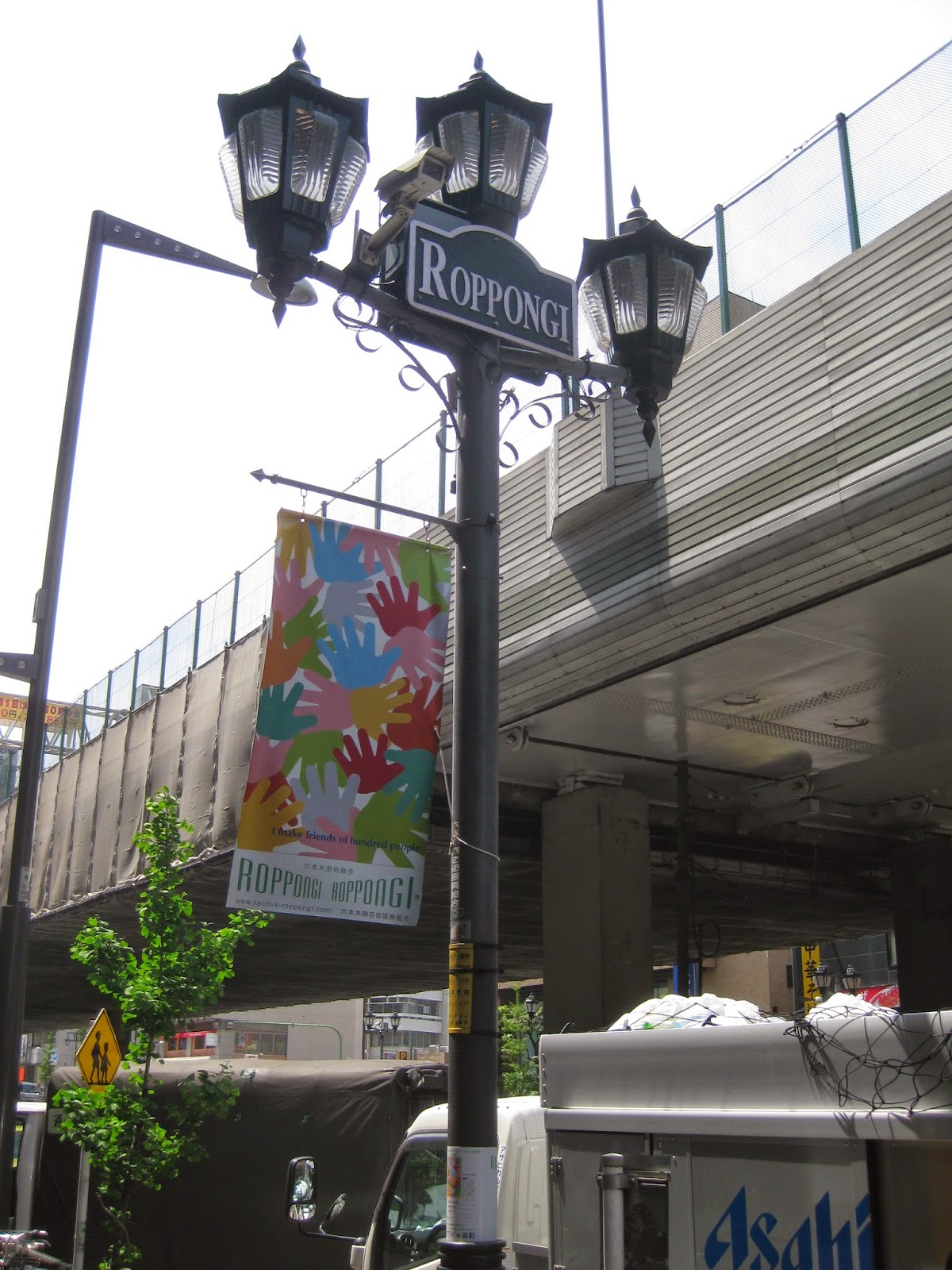
          Even if you don’t feel like hitting the bottle, you ought still to pay a visit to the nightlife centre of Roppongi. The scene that plays out at night in this famous hive of sleaze and drunkenness has to be seen to be believed. You may encounter besuited and apparently respectable Japanese businessmen passed out on the floor of the metro station, while the streets above are filled with Turkish restaurants, faux British pubs, ‘snack’ bars and smoky nightclubs throbbing with house music. A staggering number of black African men loiter on the sidewalks, desperately (and illegally) seeking to persuade booze hounds to enter establishments of ill-repute.


          It’s hard to believe, but you can go kayaking in the heart of Tokyo. Although the city’s rivers and canals are not very easy on the eye, it has to be a more rewarding way of burning calories than working out in a hotel gym. You need to be in some sort of shape to undertake the two to three hour journey with the Tokyo Great Kayaking Tour (6000 yen), for it’s a pretty exhausting Sunday morning endeavour. 

          Starting from Kayabacho, you cross the busy Sumida River, avoiding water buses and young thrill seekers, before entering the narrow and deserted waterways to the east. Here you are likely to come across small kids waving at you from bridges and hardy jellyfish that have somehow adapted to life in the city’s polluted rivers. It’s invigorating, and you’ll get a free beer or chu-hai at the end.